
Customer-Led Tariffs
Empowering customers by driving smarter, fairer electricity pricing.
Why this matters
Electricity tariffs are becoming more complex as the energy system evolves, making it harder for customers to understand and engage with their energy use and costs.
Customers are telling us they want pricing that is fair, easy to understand and supports them to make informed decisions.
As we move into Stage 3, this work shifts from alignment to testing ensuring future tariff reform is grounded in real customer experience with a strong focus on what ‘fair, clear and manageable’ pricing looks like in practice.
By sequencing customer insight, modelling and feasibility, Stage 3 helps reduce risk, avoid unintended impacts and build confidence across industry, regulators and the community.


Impact
This #BetterTogether initiative is helping to build a shared understanding across industry and consumer groups of what customer-led tariffs could look like, and how they can be designed to deliver better outcomes.
It is also supporting more coordinated, evidence-based engagement with regulatory processes and reforms.
Stage 3 update
Stage 3 will now translate this into tangible outputs including a Customer Insights Summary, tested pricing concepts through paper trials and exploration of a sandbox pathway. These insights will directly inform industry decision-making and key regulatory processes (including the AEMC Pricing Review, with this #BetterTogether initiative highlighted in the final Pricing Review) while ensuring customer protections and trust remain central.
As we move into Stage 3, focus group participants will help us test what future pricing options could look like in practice, exploring innovative tariff and subscription-style concepts and the customer preferences that shape them.
We’ve received 60+ expressions of interest for this #BetterTogether Customer-Led Tariffs initiative focus group. This strong response highlights just how important fair, clear and customer-led electricity pricing is to Australians.
CEO-led leadership
This work is championed by the CEOs of EnergyAustralia, Essential Energy and SA Power Networks, who have come together with a shared commitment to deliver pricing reform that puts customers first. Their leadership has created the space for strategic experimentation, open collaboration, and transparent learning across the sector. It’s a powerful example of the kind of cross-sector cooperation needed to drive genuine transformation.
Our CEOs endorsed key principles to guide this work and future pricing reform:
- Simple – Retail offerings should be easy to understand, explain, and compare. They should reduce complexity for customers.
- Universal – Retail offerings should be available to all residential and small business customers. They should be consistent across networks and include an ‘obligatory offer’ to act as a safeguard.
- Fair and equitable – Retail offerings should be affordable and ensure no one is left behind. One customer’s choice should not negatively affect others.
- Certainty for customers – Retail offerings should be predictable over time, with clear and consistent bill amounts and no surprises.
- Supporting customer choice – Retail offerings should support customer agency and enable meaningful choice.
- Safeguarding customers – Retail offerings should minimise harm, especially for vulnerable customers.
This #BetterTogether initiative is aligned with the Australian Energy Market Commission’s Pricing Review: Electricity Pricing for a Consumer Driven Future. Read our submission from July 2025.
„
Collaborative processes like those used by The Energy Charter are crucial because they ensure that the voices of consumer and community are heard and reflected in the decisions shaping their energy future. Through consumers and industry working together, we can create a fairer energy system with innovation that focuses on consumer outcomes that creates benefits for all, including the vulnerable and disadvantaged.
Gavin Dufty, National Director Energy Policy and Research, St Vincent de Paul Society Australia
Collaborators
Customer + Community Outcomes Group
- Energy and Water Ombudsman NSW (EWON)
- Energy Consumers Australia
- Individual lived-experience members from customer councils
- Justice and Equity Centre (formerly Public Interest Advocacy Centre)
- Rheem
- St Vincents de Paul Society Australia.
Industry Collaborators
- EnergyAustralia, led by MD, Mark Collette
- Essential Energy, led by CEO, John Cleland
- SA Power Networks, led by CEO, Andrew Bills.
Resources + additional Information
Stage 1 built a strong foundation for developing future energy tariffs that are customer-focused, support the energy transition, and enable better outcomes for both customers and the energy system.
What happened in Stage 1:
- Deep customer engagement: Over 20 diverse customer voices were involved across three jurisdictions (NSW, VIC, QLD), including vulnerable customers, First Nations people, and small businesses.
- Co-design workshops: These helped unpack how different customer segments view energy pricing and choice.
- Development of design principles: Key principles emerged from this engagement (such as simplicity, fairness, safeguarding vulnerable customers), shaping what “good” looks like in future tariffs.
- Shared understanding: The process helped build a common language between networks, retailers, advocates, and regulators.
Key outcomes:
- Strong support for a customer-first approach to tariff reform.
- Agreement on the need for choice, simplicity, and safeguards.
- Recognition that tariff reform must be grounded in real customer experience and led with empathy.
Building on the insights and design principles shaped in Stage 1, Stage 2 brought the ideas off the page and into action. We worked with independent consultants at Endgame Economics to design and model six innovative network tariff concepts from simple fixed-only options to dynamic peak-dip and aggregate structures.
Using detailed proof-of-concept modelling, these tariff designs were applied to a representative sample of 1,710 customers to understand how they perform in the real world. This hands-on testing allowed us to explore what works, what doesn’t, and what has the potential to transform how customers engage with pricing in a smarter, fairer energy system.
20 February 2025
Recently US economist and energy pricing expert Ahmad Faruqui spoke to a forum hosted by The Energy Charter on customer-led tariffs. In this guest blog, he unpacks an innovative approach to technology-specific energy rates.
Electrification has emerged as a widely accepted option for lowering carbon emissions and mitigating climate change. Utilities offer rebates and governments offer tax credits to lower the capital cost of switching to electric vehicles (EVs), heat pumps and other electric devices but these incentives make a dent in their operating costs.
High operating costs pose a substantial barrier to electrification, especially in high-cost regions. Innovative rate designs, such as time-of-use rates, applied to the whole house, can lower operating costs but usually not enough to accelerate electrification. However, by changing the rate design paradigm, and offering technology-specific rates based on the marginal cost of electricity we can make electrification affordable, since it will substantially lower operating costs without raising rates for other customers.
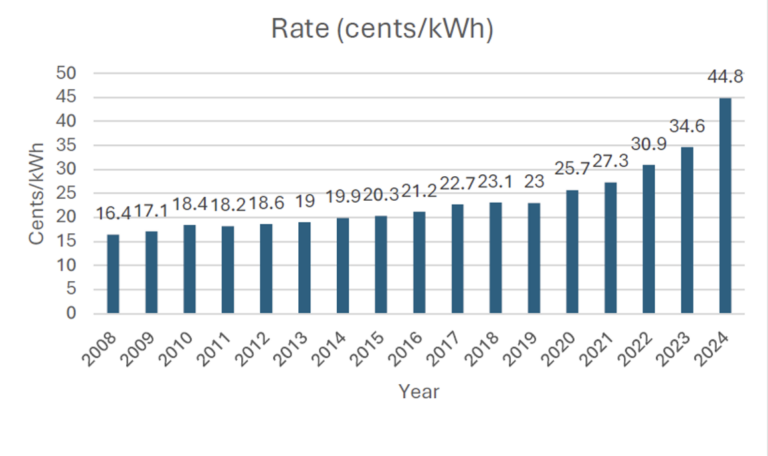
Consider the case of California. The largest utility, Pacific Gas & Electric Company (PG&E), serves northern California, which is home to 14 million people. The average residential rate stood at 44.8 cents/kWh in January 2024. Using its E-1 tiered rate as a point of reference, the price of electricity has doubled over the past seven years, far exceeding the rate of inflation. In the seven years prior to 2017, it had grown by 23%. As a point of reference, in 2008 the average retail rate was 16.4 cents/kWh. The history of the average residential rate for PG&E is shown below.
https://www.pge.com/tariffs/en/rate-information/electric-rates.html
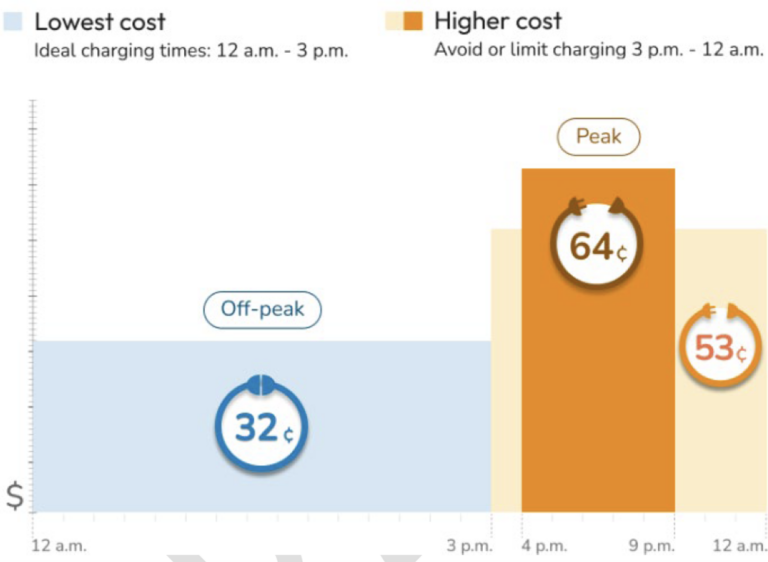
One of the popular rates available to EV customers is EV2-A.
The rate features three pricing periods, and the prices per period during the summer months are shown below.
Source: PG&E's prevailing EV tariff https://www.pge.com/en/account/rate-plans/find-your-best-rate-plan/electric-vehicles.html
Most EV drivers charge their vehicles during the off-peak period when the rate is 32 cents/kWh. If EV load is priced at the marginal cost of electricity, the price may drop to 10 cents/kWh.
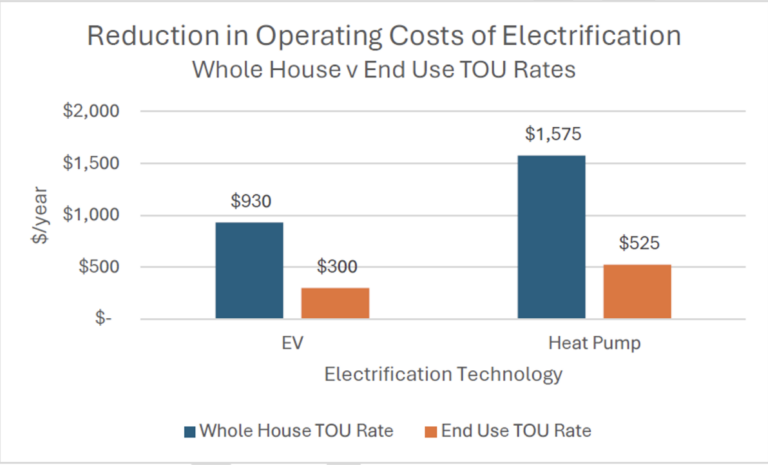
Under marginal cost pricing, a typical household whose EV load is 3,000 kWh a year would see their annual EV driving costs drop substantially, from $930 to $300. This would enhance the appeal of EVs to drivers who are in the market for a new car and should accelerate the EV adoption rate.
In the areas that lie east or south of San Francisco, or in the Central Valley, summers are hot, winters are cold. A heat pump for heating, ventilating and air conditioning (HVAC) may consume 3,500 kWh a year. In the summer, a heat pump in the cooling and ventilation mode is likely to run for several hours a day, spanning the off-peak, mid-peak and peak periods. It is likely to run most intensely in the late afternoon and early evening periods. In the winter, in the heating and ventilation mode, it is likely to run mostly in the mid-peak and off-peak periods.
If the year-round peak period price averages 55 cents/kWh, the mid-peak averages 49 cents/kWh and the off-peak price averages 31cents/kWh, then a weighted average price of 45 cents/kWh may be used to get a rough estimate of the annual operating cost of a heat pump.
With PG&E’s existing rate, that would amount to roughly $1,575. If, however, a marginal price of 15 cents/kWh is used, the cost would drop to $525, making heat pumps a substantially more attractive investment for customers, and probably accelerating their adoption rate. In both cases, operating costs fall by roughly 67%, as illustrated below.
Source: author's simulations
It should be noted that operating costs with whole house TOU are likely to be 5-10% lower than with a flat rate, as compared to the 67% reduction that would accompany technology-specific marginal cost pricing.
Similar calculations can be performed for other electrification technologies, such as heat pump water heaters and induction stoves. In some areas, electrification might run into distribution capacity constraints, requiring network capacity expansion. In such cases, estimates of marginal capacity costs would be added to marginal energy costs. In addition, electrification-focused marginal cost pricing should feature time variation in energy rates to avoid creating new peaks and to facilitate load flexibility.
The technology-specific rate would consist of two parts. The first part would be a subscription plan based on existing rates and usage, which ensures that utilities will recover their revenue. The second part, based on marginal costs, would ensure that customers who electrify will see lower bills. Society will benefit through the lower carbon emissions that will accompany electrification. The world will be better off since climate change will be mitigated. There will be no losers, i.e., it will be a Pareto Optimal policy
Ahmad Faruqui is an economist who has worked on electricity pricing issues for 45 years on six continents.
This #BetterTogether initiative aligns with:

Principle 2: We will improve energy affordability and value for customers + communities.

Learn more
Speak to Bec Jolly, Director, Energy Equity, to learn more about the #BetterTogether Customer-Led Tariffs initiative.